
The Missing Piece
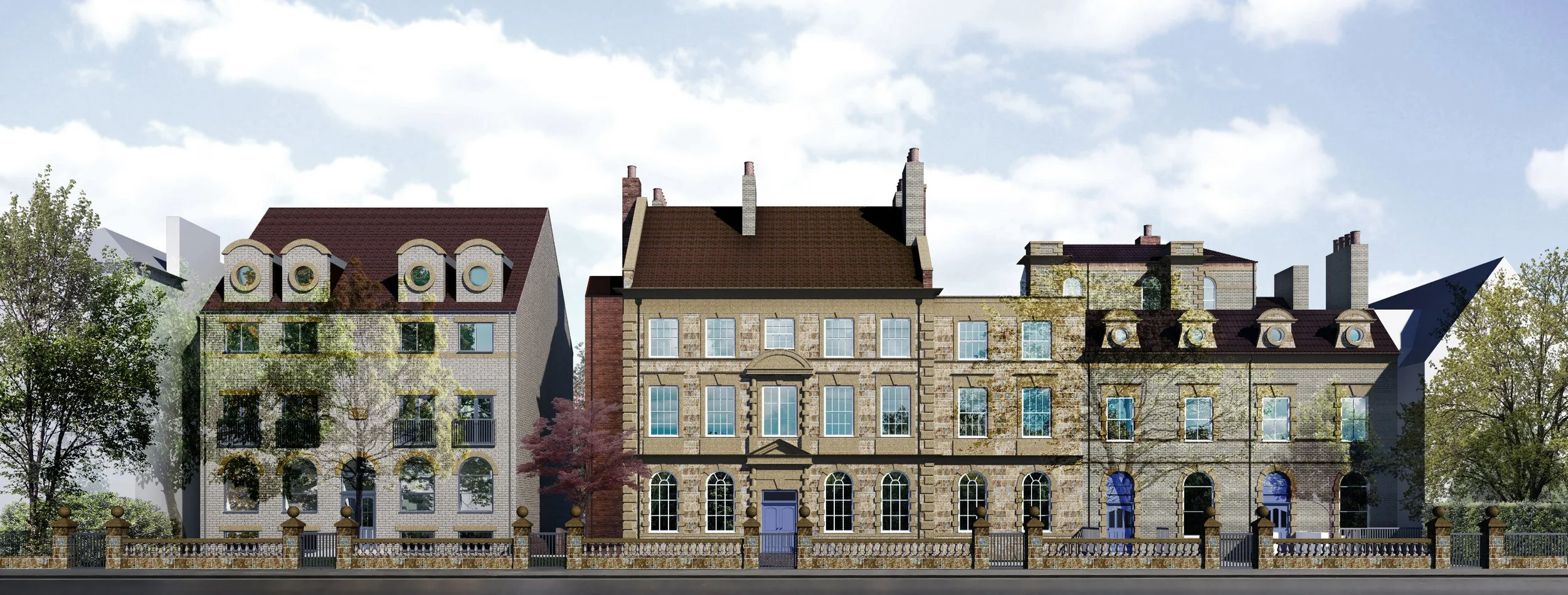
Some developments stand out because of their size. Others because of the complexity involved in making them feel as though they've always belonged.
This proposal involved designing a new apartment building on a long-vacant gap site within a historic streetscape. While developing an empty plot might sound straightforward, this was one of those projects where every design decision had to balance heritage, planning policy, residential amenity and modern housing requirements.
The result was a scheme for 14 contemporary apartments that repairs the street frontage while respecting the character of the surrounding conservation area.
The Challenge
The site occupied a prominent gap between established historic buildings within a conservation area. Rather than treating it as an isolated plot, the proposal had to become part of an existing architectural composition.
Key challenges included:
Designing a building that completed the historic street scene without mimicking neighbouring buildings.
Responding sensitively to the adjacent listed building.
Working within a constrained urban site with significant level changes.
Providing high-quality homes with excellent natural light and outlook.
Delivering sufficient parking, cycle storage and refuse facilities without compromising the overall design.
Coordinating heritage, transport, drainage, ecology, arboricultural, noise and air quality requirements into a single planning strategy.
The Solution
Rather than simply maximising development, the design focused on repairing the streetscape.
The new building continues the established building line while maintaining subtle gaps to neighbouring properties, allowing the adjacent heritage assets to retain their individual identity. Traditional proportions, carefully considered roof forms and contemporary detailing create a building that feels appropriate without becoming a pastiche.
Internally, the apartments were arranged to maximise daylight, outlook and efficient use of space despite the challenging topography, with duplex apartments incorporated into the upper floors to make full use of the available volume.
Beyond the Architecture
Projects like this are never just about producing drawings.
Alongside the architectural design, the planning submission coordinated:
Heritage assessment
Transport strategy
Arboricultural assessment
Ecology and Biodiversity Net Gain
Flood risk and drainage design
Noise assessment
Air quality assessment
Health impact assessment
Each discipline influenced the final design, requiring continual refinement to ensure the proposal remained commercially viable while satisfying planning policy.
The Outcome
The proposal demonstrates how thoughtful urban infill can create much-needed homes while strengthening the character of an established neighbourhood.
Instead of treating the vacant site as leftover space, the scheme transforms it into an integral part of the street, improving the appearance of the conservation area and making efficient use of a sustainable brownfield location.
It's a good example of the type of work we enjoy most—projects where architecture, planning strategy and technical problem-solving all have to work together to unlock sites that initially appear too constrained to develop.